
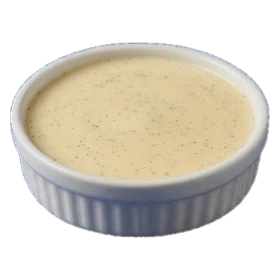
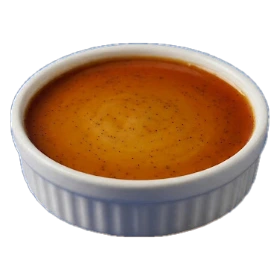
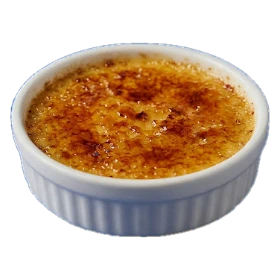
The same yolk custard, eaten from its pot or under a crust that cracks.
Three lines of recipe, not one more. The preparation is the same to the gram. The cream goes into a tall little pot and bakes at 150 °C; the brulee goes into a wide shallow ramekin, bakes at 100 °C for twice as long, and gets its crust straight out of the fridge. The wide dish is not a flourish: it is what sets the ratio of crust to cream.
The one sugar on this site that cannot be turned down. Everywhere else sugar is a seasoning and the recipe holds without it. Here the crust is a surface: it takes enough to cover the ramekin from edge to edge, and below 4 g the veil has holes and no longer cracks. It is structure, not flavour, and that is why it is counted on its own line.
Caramelise at the last moment. Dry sugar on a well-chilled cream, blowtorch, and on the table within the minute. Ten minutes later the moisture of the cream has dissolved the crust and all that is left is a sticky top.
Yolks, not whole eggs. That is what separates a cream from a flan. The white sets firm and lets you turn it out; without it the cream stays soft and is eaten with a spoon, from its pot. The whites left over go to the meringue cookies.
The bain-marie holds the temperature. Egg sets at around 65 °C; past 85 °C it contracts and squeezes its water out. The water in the dish tops out at 100 °C and climbs slowly, which the oven cannot do.
The centre must still wobble as it comes out of the oven. It finishes setting as it cools, and a custard baked until firm comes out grainy once cold.
| Per serving | Per 100g | |
|---|---|---|
| Carbs | — | — |
| Fat | — | — |
| Protein | — | — |
| Kcal | — | — |
With whole eggs and a lean liquid, the same idea turns out of its mould and becomes a flan: Vanilla flan.